A fully distributed fibre-optic instrument that continuously resolves temperature along the entire length of a standard telecommunications-grade optical fibre — eliminating the need for discrete point sensors in downhole, pipeline, conveyor, data centre and other temperature-sensitive monitoring applications.
The Distributed Temperature Sensing (DTS) interrogator is a fully distributed fibre-optic instrument that continuously resolves temperature along the entire length of a standard telecommunications-grade optical fibre. By eliminating the need for discrete point sensors, the system provides a cost-effective and intrinsically robust solution for continuous temperature profiling in downhole, pipeline, conveyor, data centre and other temperature-sensitive area monitoring applications.
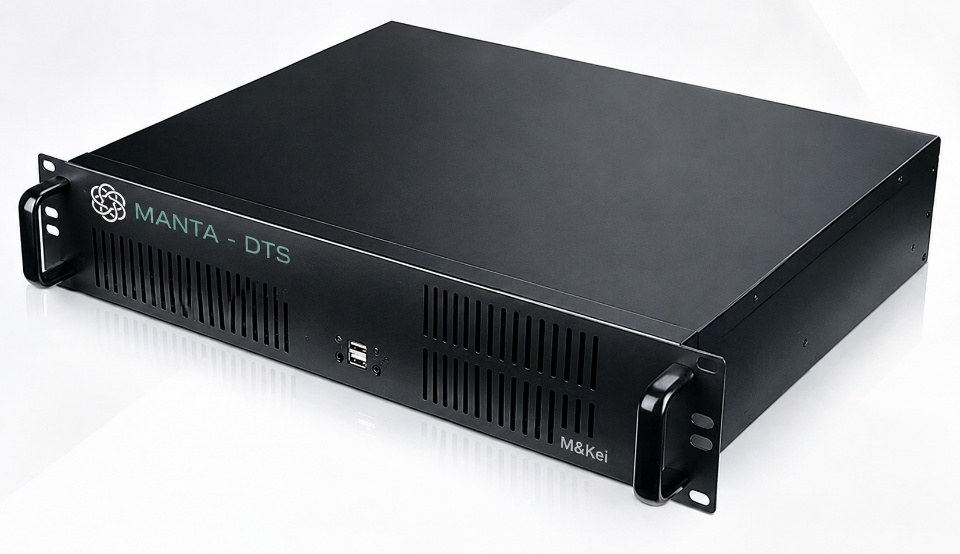
01Manta - DTS interrogator, 19" rack-mount chassis.
| Model | Manta - DTS |
|---|---|
| Fibre type | Multimode fibre, G50/125 or G62.5/125 |
| Laser source | 1550 nm |
| Measurement mode | Single-ended or double-ended |
| Measuring distance | 0–50 km |
| Number of channels | 1, 2, 4, 8, or 12 (customizable) |
| Spatial resolution | Min 0.25 m |
| Temperature accuracy | ±0.25 °C |
| Temperature resolution | 0.05 °C |
| Measuring time | 5 s to 1 h, adjustable |
| Optical connector | E2000/APC (customizable) |
| Communication interface | RS232/485, Ethernet RJ45, USB |
| External dimensions | Rackmount, 485 × 130 × 485 mm (W × H × D) |
| Power supply | 100–240 VAC, 50/60 Hz, ≤50 W |
| Storage temperature | –40 °C to 65 °C |
| Working temperature | 0 °C to 40 °C |
| Storage humidity | ≤95% RH, non-condensing |
The DTS interrogator exploits optical time-domain reflectometry (OTDR) in conjunction with the spontaneous Raman backscattering effect that occurs when a pulsed laser propagates through an optical fibre. As the pulse travels along the fibre, a fraction of the incident light is backscattered at every point along its path.
The intensity ratio between the Stokes and anti-Stokes components of the backscattered Raman signal is intrinsically temperature-dependent and constitutes the physical basis of the temperature demodulation. By simultaneously analyzing the round-trip transit time of the backscattered light, the interrogator locates the corresponding scattering point along the fibre with high spatial precision, thereby delivering a continuous temperature profile over the entire sensing length from a single measurement.
Talk to us about channel count, sensing range, and cable selection for your deployment — from a single wellbore to a multi-zone industrial site.
Talk to us See all technologies