Product — ORCA - DAS

Distributed Acoustic Sensing (DAS) Interrogator

Converts a standard single-mode optical fibre into a continuous array of virtual acoustic sensors — real-time acquisition of acoustic and vibration signals at any location along the cable, with true-phase demodulation and ProdML DAS Schema 2.0 HDF5 output.

Sensing range
10–100 km per channel
Spatial resolution
1.13 m to 100 m
Strain sensitivity
3 pε/√Hz @ 1–5 kHz
Data format
ProdML 2.0 HDF5

One fibre, thousands of virtual acoustic sensors

The Distributed Acoustic Sensor (DAS) interrogator converts a standard single-mode optical fibre into a continuous array of virtual acoustic sensors, enabling real-time acquisition of acoustic and vibration signals at any location along the cable without any downhole electronics. Because sensing and signal transmission are performed by the same fibre, a single cable is functionally equivalent to thousands of discrete point sensors. The ORCA - DAS interrogator is a true-phase demodulation instrument that outputs unwrapped phase data, in the ProdML DAS Schema 2.0 HDF5 data format.

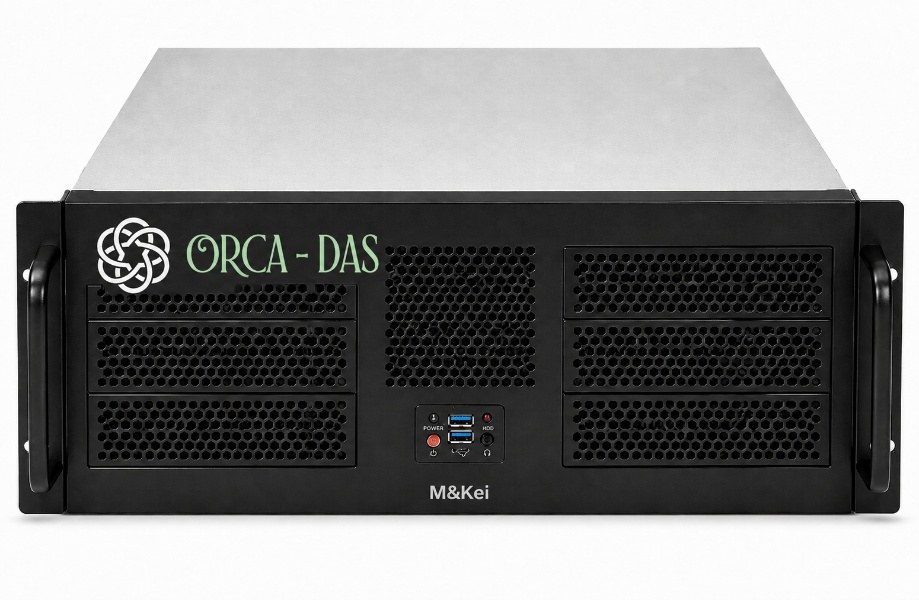
ORCA DAS distributed acoustic sensing interrogator — rack enclosure system

01ORCA - DAS interrogator — photoelectric detection module and processing unit in a 4U+2 rack enclosure.

Specification

ModelORCA - DAS
Measuring distance (per channel)10–100 km
Fibre modelSingle-mode fibre
Spatial resolution1.13 m to 100 m
Sampling interval0.2 m to 10 m, variable
Sample rateUp to 500 MS/s
Response timeAs low as 1 s
Detectable frequency range0.01–20 kHz (dependent on measuring distance)
Strain sensitivity3 pε/√Hz at 1–5 kHz
Optical connectorE2000/APC
Power supply220 VAC, 50 Hz, 100 W
Operating temperature0 °C to 40 °C
Storage temperature–20 °C to 65 °C
Communication interfaceEthernet, USB, RS232
Data storage20 TB (expandable)
Chassis / footprint4U+2 rack enclosure: 1 photoelectric detection module, 1 processing unit

Coherent Rayleigh backscattering with differential coherent detection

The DAS interrogator operates on the principle of coherent Rayleigh backscattering. A highly coherent laser pulse is launched into the single-mode sensing fibre, and minute, naturally occurring inhomogeneities distributed along the fibre core continuously backscatter a small fraction of the incident light. External acoustic or vibrational disturbances perturb the local strain field of the fibre, modulating the phase of the backscattered light at the corresponding location.

A differential coherent-detection architecture demodulates this phase information quantitatively, yielding a substantially higher signal-to-noise ratio than direct-detection designs, while allowing spatial resolution and other acquisition parameters to be reconfigured entirely in the digital domain. This approach effectively suppresses the signal-fading artefacts inherent to coherent OTDR systems and, combined with an ultra-low-frequency (ULF) demodulation capability, extends the usable frequency range to support high-precision measurement in oil and gas applications.

The delivered system comprises a complete photoelectric interrogation unit, data-acquisition module, and demodulation/software suite built on a common architecture.

Key features

Typical applications

Planning an acoustic or seismic monitoring deployment?

Talk to us about sensing range, frequency band, and timing configuration for your wellbore, pipeline, or perimeter application.

Talk to us See all technologies